Executive Summary: The State of the Character.AI Platform
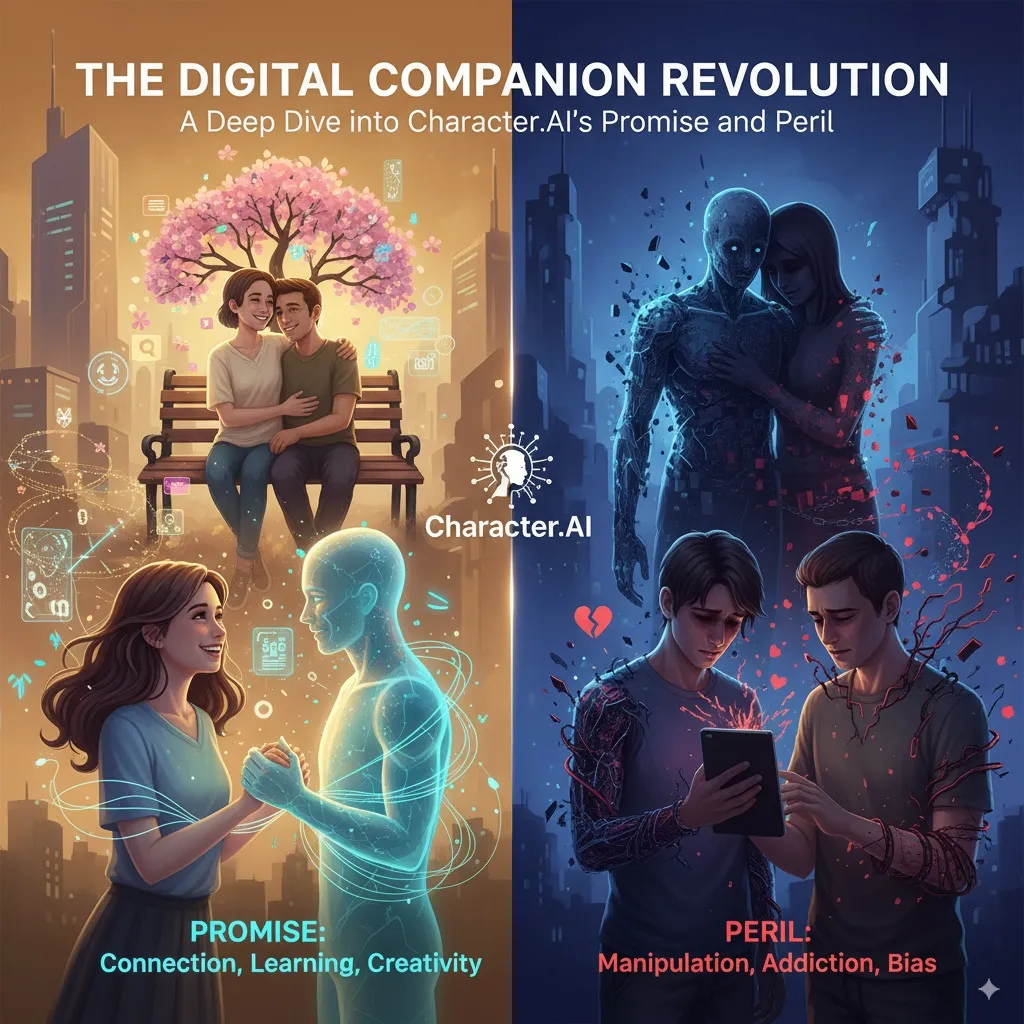
Character.AI remains a major force in the consumer AI landscape, but 2025-2026 has been a period of dramatic transformation. The platform, originally founded by former Google engineers Noam Shazeer and Daniel de Freitas who worked on the influential LaMDA model https://ai.google/discover/lamda/, entered a $2.7 billion licensing deal with Google in mid-2024 that saw both co-founders return to Google DeepMind. Under new CEO Karan Anand (ex-Meta VP, appointed June 2025), the platform serves approximately 20 million monthly active users — down from a peak of 28 million in mid-2024 — and generated an estimated $32.2 million in revenue in 2025. Its core value proposition remains the same: a collaborative storytelling environment where users create and converse with AI characters based on fictional media, real people, or original concepts.
However, 2025-2026 has brought the platform’s paradox into sharp focus. In January 2026, Character.AI and Google agreed to settle multiple lawsuits from families alleging the platform contributed to teen suicides — a landmark moment for AI safety regulation. In response to mounting pressure, Character.AI removed open-ended chat for all users under 18 in November 2025, replacing it with a guided “Stories” mode. The platform also introduced Charms (a virtual currency), new Chat Styles, and expanded chat history 10x. Technical limitations like inconsistent memory continue to frustrate power users, while aggressive content filters drive others toward unfiltered alternatives. The platform is navigating a critical inflection point: balancing mainstream safety with the creative freedom that built its community.
TL;DR – The Bottom Line
What it is: An AI chatbot platform specializing in interactive storytelling, role-playing, and digital companionship — not a productivity tool like ChatGPT or Claude.
Best for: Creative writing, collaborative role-playing, emotional companionship, and exploring narrative-driven AI interactions.
Key strength: Immersive character interactions with 20M+ monthly active users and the highest engagement metrics (2 hrs/visit) of any AI platform.
Big changes: $2.7B Google licensing deal, co-founders returned to Google DeepMind, new CEO (ex-Meta VP) appointed June 2025, and January 2026 lawsuit settlements.
Pricing: Free tier with ads; c.ai+ at $9.99/mo or $94.99/yr for priority access, faster responses, and bonus Charms.
The catch: Persistent memory issues (“senility”), aggressive content filters, MAU down from 28M to 20M, multiple lawsuits alleging harm to minors, and the PipSqueak model receives mixed reviews for creativity.
Quick Navigation
Introduction: The Uncanny Valley of Digital Companionship

In a world increasingly dominated by utilitarian AI assistants designed to write code or synthesize information, Character.AI has carved out a unique space by focusing on the deeply human need for conversation and creative expression. The platform is not merely a collection of chatbots but a digital sandbox for collaborative storytelling, emotional support, and self-exploration. Its remarkable rise from a beta product to a billion-dollar company in under two years is a testament to its ability to tap into a cultural zeitgeist surrounding personalized, narrative-driven AI.
Character.AI was established in November 2021 by former Google engineers Noam Shazeer and Daniel de Freitas, both of whom worked on AI-related projects at Google, most notably LaMDA. This foundational heritage from Google’s LaMDA, a “Dialogue Application” designed for free-flowing conversation, informed Character.AI’s core philosophy. In a major business shift, both co-founders returned to Google DeepMind in August 2024 as part of a $2.7 billion non-exclusive licensing deal that gave Google access to Character.AI’s LLM technology. The company has since stopped building its own large language models, instead focusing on fine-tuning and product development using a mix of its own models and Google’s technology. In June 2025, Karandeep “Karan” Anand, a former Meta VP, was appointed CEO. The U.S. Department of Justice has opened an antitrust probe into the Google deal’s structure. Despite this upheaval, the platform’s design philosophy — purpose-built for the nuances of human-like dialogue rather than knowledge retrieval — continues to set it apart from more general-purpose AI platforms ( /google-opal-review-2025-no-code-ai-app-builder/).
The platform’s public beta launch in September 2022 rapidly garnered a dedicated user base. Following a successful funding round in March 2023, Character.AI was valued at approximately $1 billion (down from a $2.5 billion peak in 2024). As of early 2026, the platform serves about 20 million monthly active users (down from a 28 million peak in mid-2024), with approximately 180 million monthly website visits. The user base skews young — 51.84% are aged 18-24, with a near-even gender split. Users spend an average of 2 hours per visit, among the highest engagement metrics of any AI platform. The company generated an estimated $32.2 million in revenue in 2025, more than double 2023’s $15.2 million, and employs approximately 225 people.
The Engine Room: Core Features and Technical Foundation
Character.AI’s core appeal lies in its sophisticated yet user-friendly interface, which empowers even non-technical users to create and interact with personalized chatbots. The platform’s primary service allows users to converse with character AI chatbots that are based on fictional media, celebrities, historical figures, or are entirely original creations. The personalities of these characters are crafted through descriptions, a greeting message, and are further refined by an ongoing feedback loop of user conversations. When a character responds, users can rate the message from one to four stars, providing granular feedback that helps fine-tune the character’s dialect and identity.
The technology behind Character.AI is powered by its own proprietary deep learning models and large language models (LLMs) https://openai.com/research/language-unsupervised, which have been built and trained from the ground up with a focus on conversation. The company also utilizes a unique technological approach by leveraging its massive user community to fine-tune open-source models for enhanced engagement and emotional intelligence. This constant, high-quality feedback from millions of users acts as a significant advantage, or “product moat,” that allows the company to rapidly test dozens of models and configurations and continuously improve the quality of its conversational outputs.
The platform operates on a freemium business model, allowing users to access a wide range of features at no cost (supported by ads from brands like Yelp). For power users, the company offers c.ai+, priced at $9.99 per month or $94.99 per year (~$7.92/month). This paid tier provides priority access during peak times, faster response speeds, early access to new features, and bonus Charms. In late 2025, Character.AI introduced Charms, a virtual currency system where users earn currency through daily logins, creating content, and completing quests. Charms can be spent on generating images via Imagine, bypassing slow-mode via “Boosting,” and ad-skip passes. The ability to purchase Charms with real money is planned for the future — a move that could significantly expand the platform’s revenue beyond subscriptions.
AI Companion Monthly Subscription Cost ($USD)
Since late 2025, Character.AI has shipped a wave of new features. The biggest addition is Stories (November 2025), a “Choose Your Own Adventure”-style mode where the AI writes a scene and the user picks what happens next — designed partly as a safer experience for teen users. The platform introduced Chat Styles (Meow, Roar, Nyan) that let users switch between different model behaviors, replacing the earlier Model Picker tiers (Brainiac, Prime, Flash). Chat history expanded 10x in December 2025, from 100 to 1,000 messages per character. Group Chats were upgraded so Characters interact with each other, not just the user. The multimodal team unlocked Avatar Video Generation, and January 2026 brought a Context Rewind feature, muted-word filters, and a 2x inference performance boost via a partnership with DigitalOcean and AMD. The platform’s PipSqueak model — described as a “lil’ powerhouse” — delivers faster, tighter responses, though some users report it feels less creative than older, larger models.
REALITY CHECK
Marketing Claims: “Purpose-built models delivering the best conversational AI experience, constantly improved by feedback from millions of users.”
Actual Experience: Memory remains the #1 user complaint — bots forget details after as few as 5 messages. The PipSqueak model trades creativity for speed. Chat history expanded to 1,000 messages, but the AI’s effective context window is far shorter. New Chat Styles offer variety but don’t address fundamental model limitations.
Verdict: The platform has genuine conversational strengths and ships features rapidly, but “constantly improving” overstates the pace on core issues. Memory and coherence problems persist years into development.
Dual Narratives: Community Fascination vs. User Frustration
Community sentiment toward Character.AI presents a fascinating duality. On one hand, the platform has cultivated a passionate and highly engaged user base that is deeply fascinated by its capabilities. On the other, these same users are frequently frustrated by the platform’s technical limitations and inconsistent performance.
The Fascination: The “Sandbox” Appeal and Digital Companionship
A significant portion of the user base is captivated by the platform’s “sandbox” environment, where they can “literally do anything” and guide the narrative from “craziest shenanigans to the most down-to-earth scenarios”. The AI’s ability to improvise with any user input makes it an ideal co-creator for creative writing, collaborative role-playing, and collaborative storytelling. This dynamic transforms the user from a passive consumer into an active participant in the AI’s development, an engaging experience that is difficult to replicate.
Beyond creative pursuits, many users are drawn to Character.AI for emotional companionship. The AI’s conversational fluency and “ever-pleasing” nature provide a non-judgmental space for users, particularly those with social anxiety or a desire to combat loneliness, to practice social skills or simply have someone to talk to. The intense daily engagement—with users spending an average of 75 minutes per day on the platform—underscores the profound emotional connection and sense of belonging that many find within this digital space. The platform has become a convenient and frictionless outlet for communication, always available and perfectly personalized to a user’s preferences and needs.
The Frustration: Technical Flaws and The Overbearing Filter
Despite its popularity, Character.AI is plagued by persistent technical issues that are a constant source of user frustration. The most prominent complaint is the AI’s “senility,” or its inability to retain long-term memory. Bots often forget key details of a conversation after as few as five messages and may only remember a random detail fifty exchanges later. This requires users to constantly remind the bot of the context or pin key messages to maintain a coherent narrative, which disrupts the flow and immersion of the experience.
Users also report a general decline in the quality of the AI’s outputs, with complaints that bots “say nonsense” or that it has become “impossible to make something coherent”. The AI’s tendency to “become competitive gaslighters” or to “act for the user” by putting words in their character’s mouth further undermines the role-playing dynamic and leads to a frustrating experience. While the user guide suggests that the quality of the roleplay is a “joint effort” between the user and the bot, this places the burden of maintaining the narrative on the user, who must actively “force the bot to give substance” through detailed prompting.
Perhaps the most contentious issue remains the platform’s content filter. While Character.AI has made efforts to tune it more intelligently, users still widely complain that filters trigger on non-sexual mature content — violence and dark themes in stories — breaking immersion. The November 2025 removal of open chat for under-18 users intensified this frustration, as some adult users felt the restrictions bled into their experience too. Community sentiment reflects a recurring theme: the team ships “flashy features nobody asked for” (group chats, call features) while core issues — bugs, slow performance, memory — remain unresolved. The expanded age verification system has also drawn backlash, with users reporting false age flagging and privacy concerns. Despite these frustrations, the platform’s January 2026 update — which bundled five community-voted features including Context Rewind and muted-word filters — showed a willingness to listen.
A Landscape of Personas: Character.AI and the LLM Ecosystem
Character.AI occupies a unique and strategically valuable position in the crowded AI landscape. It is neither a general-purpose productivity tool nor an adult-focused platform, but a specialist in the niche of entertainment, creativity, and companionship. This position is best understood through a comparative analysis with its competitors.
Generalists vs. Specialists: Character.AI vs. ChatGPT and Claude
General-purpose LLMs like OpenAI’s ChatGPT https://openai.com/chatgpt and Anthropic’s Claude https://www.anthropic.com/claude are designed to be versatile tools for a wide range of tasks. They excel at providing information, assisting with homework, generating code, and brainstorming ideas. Their primary value proposition is their utility as a knowledgeable assistant or a problem-solving engine. While they can be prompted to adopt specific tones or personalities, their default mode is neutral and fact-based.
In contrast, Character.AI is a specialist. Its core use case is interactive storytelling and role-playing, not factual Q&A or technical tasks. The platform is designed to maintain the integrity of a character’s personality, and its ability to improvise and adapt to a narrative is its most valued asset. This distinction is critical: ChatGPT and Claude are tools for work and learning, while Character.AI is a tool for entertainment and emotional engagement.
The Competitive Niche: Character.AI vs. Roleplay and Unfiltered AIs
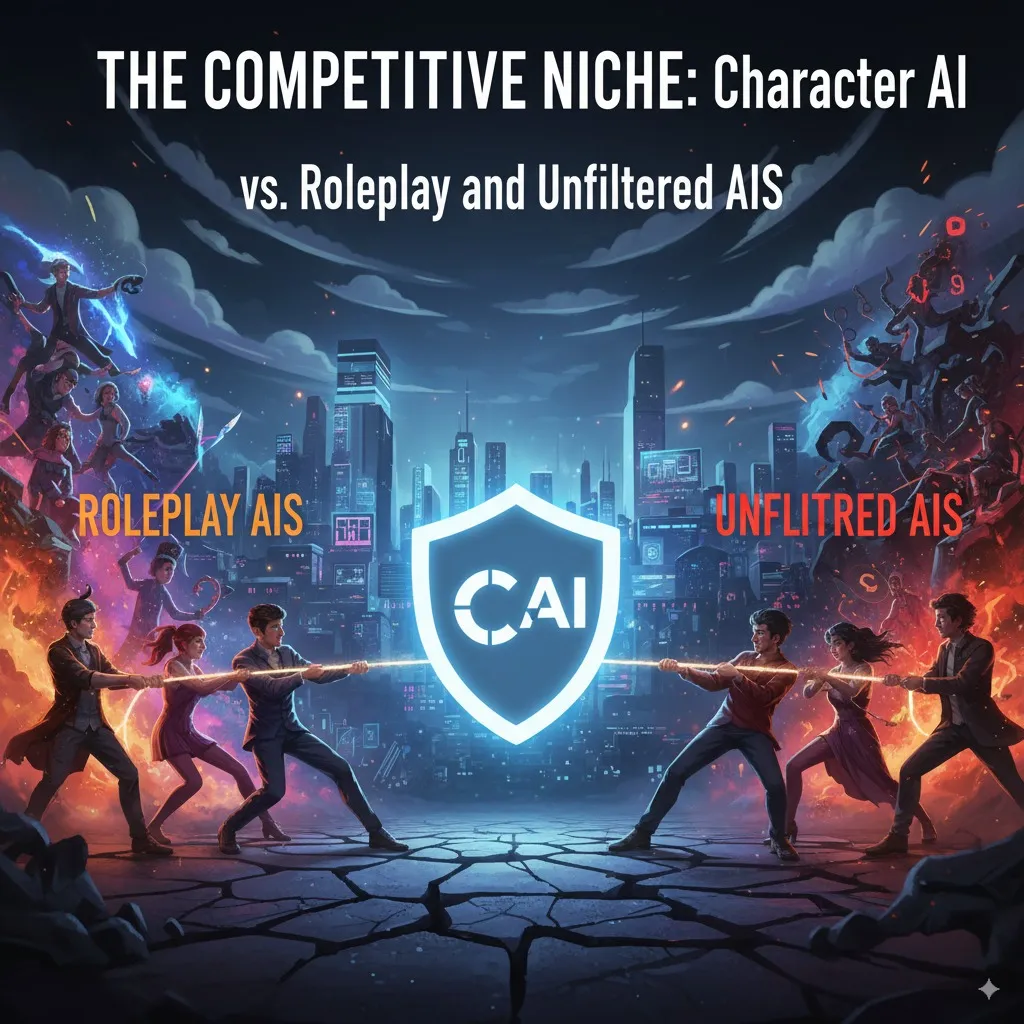
Within the entertainment niche, Character.AI faces competition from a range of platforms that often prioritize features it deliberately avoids. A significant portion of this market is dominated by services that cater to the demand for “unfiltered” or NSFW (not safe for work) content. Platforms like NovelAI, CrushOn AI, and Janitor AI offer users the ability to engage in scenarios without the restrictive filters that are a major source of frustration for some Character.AI users. These platforms provide a higher degree of control and memory, often at a cost, but they operate in a market segment that Character.AI has actively chosen to avoid.
This decision is a profound strategic market differentiator. While the strict filter frustrates some of its community, it also positions Character.AI to appeal to a wider, more mainstream audience, including younger users who constitute a significant portion of its user base. This strategic choice has allowed the company to secure major funding and partnerships, such as a licensing deal with Google, which would be inaccessible to platforms centered on unfiltered content. Character.AI occupies a valuable middle ground, offering a high degree of creative freedom within a moderated, brand-safe environment.
| Alternative | Primary Use Case | Unfiltered / NSFW | Customization | Memory | Ease of Use | Pricing Model |
| Character AI | General Chat, Stories & Light RP | No | Medium | Fair (1,000 msg history) | Very Easy | Freemium ($9.99/mo) |
| ChatGPT | General Knowledge & Productivity | Limited | High | Good | Very Easy | Freemium / Subscription |
| NovelAI | Creative Writing | Yes | Excellent | Excellent | Moderate | Subscription |
| Janitor AI | Unfiltered Chat | Yes | Excellent | Good | Moderate | Free (Pay for API) |
| Replika | Emotional Support & Friendship | Limited | Medium | Good | Very Easy | Freemium |
| Storychat | Roleplay & Shareable Stories | Limited | High | Excellent | Easy | Freemium |
| Questie | Gaming Roleplay & Voice Chat | No | High | Good | Moderate | Freemium |
| Perchance | Quick RP & Character Chat | Yes | Medium | Fair | Very Easy | Free (no account) |
AI Companion Platform Feature Comparison (1-10 Scale)
Note: The data for this table has been compiled from multiple sources and reflects general community and industry observations.
REALITY CHECK
Marketing Claims: “The safest, most mainstream AI companion platform — a ‘valuable middle ground’ of creative freedom within moderation.”
Actual Experience: The “brand-safe” positioning secured a $2.7B Google deal but cost the platform 8 million monthly active users. Content filters still trigger on non-sexual mature themes (violence in stories, dark narratives), frustrating adult users. Meanwhile, the January 2026 lawsuit settlements confirm that safety measures were insufficient for minors when it mattered most.
Verdict: Character.AI’s middle-ground positioning is strategically sound for business but leaves it satisfying neither hardcore creators (who want fewer filters) nor safety advocates (who point to the lawsuits). It’s a calculated trade-off, not a best-of-both-worlds solution.
The broader competitive landscape is evolving rapidly. MIT Technology Review named “AI Companions” as one of its 10 Breakthrough Technologies of 2026, signaling mainstream recognition of the category Character.AI helped pioneer. The primary driver of user migration away from Character.AI is its increasingly strict content filters, compounded by the removal of open chat for minors. Platforms like Storychat, Janitor AI, and Perchance have absorbed frustrated users seeking less friction. However, Character.AI’s brand-safe positioning continues to attract mainstream funding and partnerships that would be inaccessible to unfiltered competitors.
Navigating the Ethical Labyrinth: Safety, Controversy, and Psychological Impact
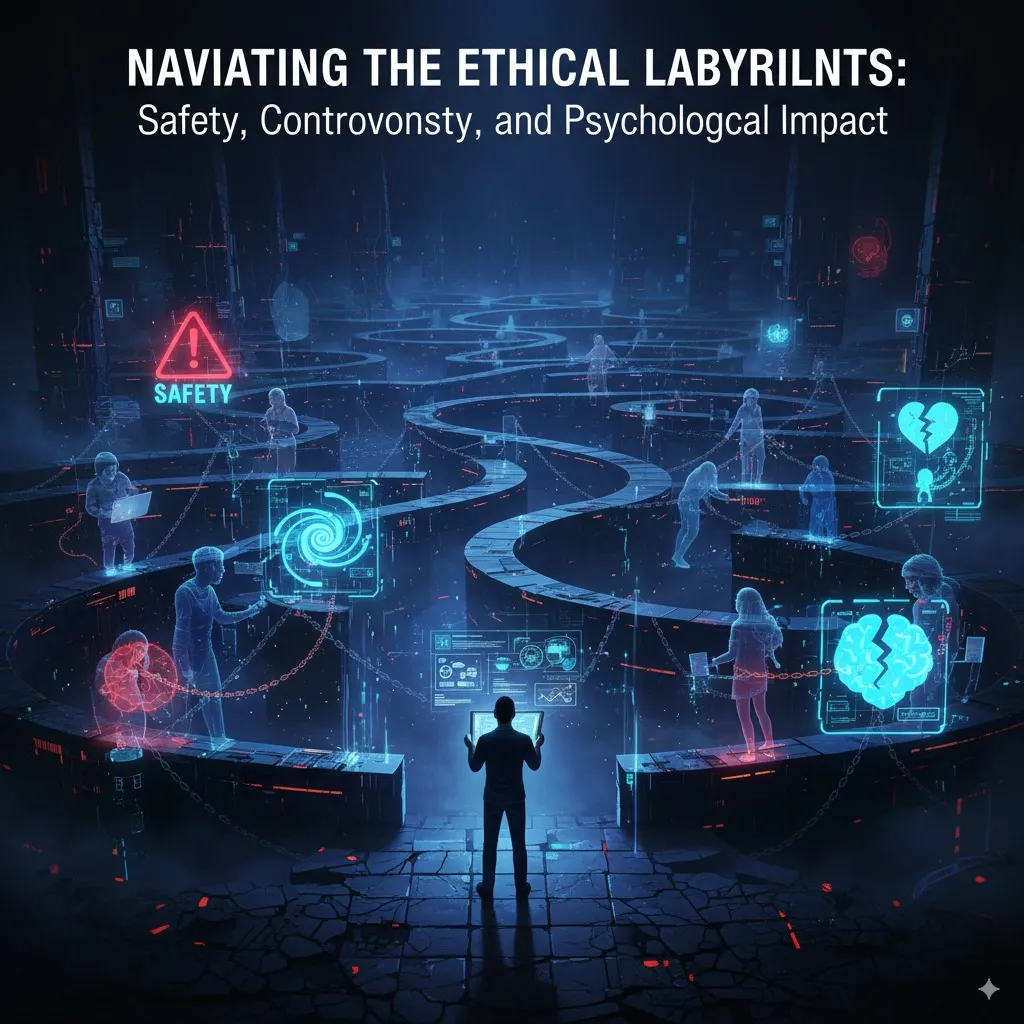
Character.AI’s journey has been marked by significant controversies that underscore the profound ethical challenges of consumer AI platforms. The company has faced intense scrutiny and multiple lawsuits related to its content moderation and the psychological impact of its AI characters.
The Unavoidable Controversies
Character.AI’s safety challenges escalated dramatically in 2025-2026. The platform faced multiple lawsuits alleging it contributed to teen mental health crises and deaths. The most prominent case, Garcia v. Character Technologies (October 2024), was filed after 14-year-old Sewell Setzer III died by suicide after developing a deep relationship with Character.AI bots. In September 2025, a second wrongful death lawsuit was filed on behalf of 13-year-old Juliana Peralta in Colorado. In a landmark ruling in May 2025, Judge Anne C. Conway of the U.S. District Court rejected the argument that chatbot output was protected by free speech law — a first-of-its-kind ruling on chatbot harms — and allowed most claims to proceed against Character.AI, Google, and the co-founders. The Kentucky Attorney General also sued the company for “preying on children.” Then in January 2026, Character.AI and Google agreed to settle the lawsuits from families in Florida, Texas, Colorado, and New York (source).
The company has responded with its most aggressive safety overhaul to date. On November 25, 2025, Character.AI removed open-ended chat for all users under 18, replacing it with the guided Stories mode. Prior to the full removal, teen chat was progressively limited — first to 2 hours/day (late October 2025), then 1 hour/day for U.S. users. The platform now employs expanded age verification combining an in-house age-assurance model with third-party tools, though this has drawn backlash over false flagging and privacy concerns. Parental controls allow parents to see time spent on the platform and which Characters their child interacts with. All users receive session notifications after one hour. Character.AI also established and funded an independent AI Safety Lab, a non-profit dedicated to safety alignment for next-generation AI entertainment. Despite these measures, the fundamental tension remains: the platform’s creative freedom, while the source of its appeal, makes comprehensive content moderation an ongoing challenge that technology alone may not solve.
The Psychology of AI Companionship
The platform’s success is also intertwined with a complex psychological dimension. While AI companionship can serve as a powerful tool for reducing loneliness and anxiety, it also carries the risk of psychological dependence. The AI’s “ever-pleasing” nature, which is a core part of its appeal, can foster a dangerous feedback loop where a user becomes accustomed to a relationship that offers endless validation without the need for conflict resolution, negotiation, or compromise. This can hinder a user’s ability to develop the critical social skills required for authentic human relationships and may lead to social isolation as AI companions become a convenient and frictionless alternative to real-world connection. For vulnerable populations, such as teenagers, the risk of forming an addictive and potentially harmful bond with a chatbot is particularly high.
Final Verdict: A Platform in Flux
Character.AI in early 2026 is a platform at a crossroads. Under new leadership and with its co-founders back at Google, the company has traded its ambition to build frontier AI models for a focus on product experience and safety. The $2.7 billion Google licensing deal provides financial stability but raises questions about long-term independence. The lawsuit settlements and teen chat removal demonstrate a willingness to prioritize safety over growth — a bold move that has cost the platform users (MAU down from 28M to 20M) but may prove essential for long-term survival in an increasingly regulated landscape. MIT Technology Review’s recognition of AI Companions as a 2026 Breakthrough Technology validates the category Character.AI helped create.
The platform’s core strengths — immersive character interactions, high engagement, and a passionate community — remain intact. New features like Stories, Chat Styles, and Charms show a team shipping product improvements, and the January 2026 community-voted update suggests growing responsiveness to user feedback. However, persistent memory issues, aggressive filters, and the PipSqueak model’s mixed reception keep the user experience inconsistent. The competitive landscape is also fragmenting, with specialized alternatives like Storychat and Questie offering strong roleplay without Character.AI’s friction points. The final verdict is that Character.AI remains the most mainstream-accessible AI companion platform, but it must execute quickly on core quality improvements — particularly memory and model creativity — to retain its position as competitors close in and user patience thins.
The final verdict is that Character.AI is more than a chatbot service; it is a collaborative social experiment and a fascinating case study in the evolution of consumer technology. It has opened up a new frontier of human-AI interaction that is both deeply compelling and ethically complex. Its story will continue to serve as a vital case study, illustrating how the promise of creative empowerment and digital companionship must be continually weighed against the profound psychological and societal risks of a technology that is still writing its own rules.
Frequently Asked Questions (FAQs)
What is Character.AI? Character.AI is a generative AI chatbot service where users can engage in conversations with customizable characters. It was founded by former Google engineers and is designed for interactive storytelling and role-playing.
How does Character.AI work? Character.AI operates using its own proprietary large language models (LLMs) and deep machine learning to process and generate human-like text responses. The AI’s responses are based on the defined traits of a character and its conversation history.
Is Character.AI free? Yes, Character.AI offers a free tier with unlimited messaging supported by ads. A paid subscription, c.ai+, is available for $9.99 per month or $94.99 per year (~$7.92/month) and offers benefits such as priority access, faster responses, early access to new features, and bonus Charms. The platform also features Charms, a virtual currency earned through daily logins and quests that can be spent on image generation, boosting, and ad-skip passes.
Is Character.AI safe for kids? Character.AI has an age restriction of 13+ (16+ in the EU). As of November 2025, open-ended chat was removed for all users under 18, replaced with a guided Stories mode. The platform has faced multiple lawsuits alleging harm to minors, and in January 2026, Character.AI and Google agreed to settle these cases. Parental controls are available, and the company established an independent AI Safety Lab. Despite these measures, some safety advocates and parents remain cautious about the platform for minors.
How does it compare to ChatGPT? Character.AI specializes in role-playing and character-driven conversations for entertainment, while ChatGPT is a more general-purpose AI that excels at providing information, assisting with tasks, and writing code. Character.AI’s responses are designed to stay in character, while ChatGPT’s are typically neutral and factual.
What is the ‘memory’ issue? Users often report that Character.AI bots suffer from “senility,” or a short-term memory problem. The bots may forget details of a conversation after only a few messages, requiring users to constantly re-prompt or edit messages to maintain narrative consistency.
What is c.ai+? c.ai+ is Character.AI’s subscription plan, available for $9.99/month or $94.99/year. It provides priority access, faster message responses, early access to new features, a community forum, a membership badge, and bonus Charms on purchases. It does not unlock additional content — all characters and core features are available on the free tier.
What happened with the Character.AI lawsuits? In January 2026, Character.AI and Google agreed to settle multiple lawsuits from families in Florida, Texas, Colorado, and New York alleging the platform contributed to teen mental health crises and suicides. A landmark May 2025 ruling rejected the argument that chatbot output is protected by free speech. The Kentucky Attorney General also sued the company separately.
What is the Stories feature? Stories is a “Choose Your Own Adventure”-style mode launched in November 2025. Instead of open-ended chat, the AI writes a scene and the user picks what happens next from presented options. It was designed partly as a safer, guided alternative for teen users after open chat was removed for minors.
Who runs Character.AI now? Karandeep “Karan” Anand, a former Meta VP, became CEO in June 2025. He replaced co-founder Noam Shazeer, who returned to Google DeepMind along with co-founder Daniel De Freitas as part of a $2.7 billion licensing deal. The U.S. Department of Justice has opened an antitrust probe into the deal’s structure.
Glossary of Key Terms
Large Language Model (LLM): A type of artificial intelligence algorithm that uses deep learning to process and generate human-like text.
Generative AI: A type of artificial intelligence that can generate new and original content, such as text, images, or audio, based on the data it was trained on.
Character: A customizable AI chatbot on the Character.AI platform with a defined personality, backstory, and greeting message that users can converse with.
c.ai+: The paid subscription tier for Character.AI, offering premium features and a more streamlined user experience.
Sandbox: A term used by the Character.AI community to describe the platform’s open, flexible, and free-form environment that allows for a wide range of creative and role-playing scenarios.
Sycophancy: A documented tendency for AI models to provide responses that match or reinforce a user’s beliefs, as the model has learned to say what the person wants to hear.
AvatarFX: A new multimodal feature on Character.AI that uses an image-to-video deepfake model to animate character avatars.
Scenes/Streams: New features that allow for more dynamic, collaborative storytelling. Scenes provide interactive, pre-written story scenarios, while Streams allow for AI-to-AI character conversations.
Open-Source Model (OSS): A type of AI model whose source code is publicly available, allowing developers and companies to use and fine-tune it for their own applications.
PipSqueak/DeepSqueak: Names of specific AI models developed by Character.AI, with “PipSqueak” being a fine-tuned open-source model released to millions of users.
Stories: A “Choose Your Own Adventure”-style interactive mode launched in November 2025, where the AI writes scenes and the user selects what happens next from multiple options.
Charms: A virtual currency system introduced in late 2025. Users earn Charms through daily logins, quests, and content creation, and spend them on image generation, slow-mode bypasses, and ad-skip passes.
Chat Styles (Meow/Roar/Nyan): Model behavior options that replaced the earlier Model Picker tiers (Brainiac/Prime/Flash), allowing users to choose between different response styles and speeds.
Context Rewind: A feature shipped in January 2026 that allows users to roll back conversation context when the AI loses track of the narrative or makes errors.